Is Your Optimization Solution a Risk During a Heat Wave? What We Found Is the Opposite

Insights from Optimum Energy subject matter experts Jesse Ohm, PE, and Kyle Clayton informed this article.
Peak load is when optimization saves the least and matters the most.
A heat wave does not break a central plant. It finds the weaknesses that were already there and surfaces all of them on the same afternoon.
A cooling tower that has lost capacity. A chiller that has been drifting out of tolerance since spring. Control sequences written for a design day the plant has not actually seen in years. Pumps that have not been rebalanced in a long time. None of it shows up in mild weather, because mild weather leaves enough margin to hide it. The plant makes its temperature, nobody gets a call, and the problem waits.
Then the forecast breaks 100 and every one of those problems arrives at once.
The useful question is not how to get through that afternoon. It is whether you could have known about all of it in March.
First, What We Mean by a Chiller Plant
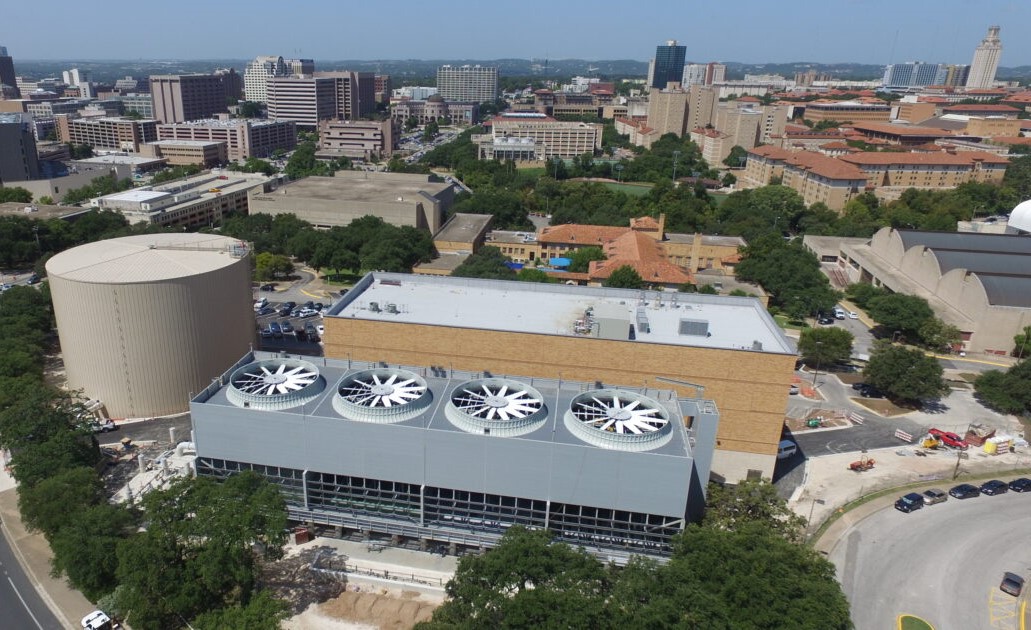
A chiller plant, also called a cooling plant or a central plant, is the equipment that makes cold water for a building or a campus. Chillers pull heat out of water and send it back out cold. Pumps move that chilled water to air handlers across the facility, where it absorbs heat from the air before returning, warmer, to be cooled again. The heat has to go somewhere, so cooling towers reject it to the outdoors.
Most plants have several chillers along with the pumps, towers, and valves that support them, and something has to decide which combination runs at any given moment. That decision is not obvious. The same cooling load can be met many ways, and the options differ enormously in energy use and in how hard they work the equipment. Chiller plant optimization makes those calls continuously from live data, not from fixed rules written years ago. How many chillers to run and which ones. How fast pumps and tower fans should spin. What temperatures to target as conditions shift.
It is a control layer, not an accessory, and on the hottest day of the year its most valuable output is not a lower utility bill.
The First Line of Defense Happens Months Before the Forecast
Most of what determines how a plant performs in a heat wave happens long before the heat wave arrives.
OptiCX® runs continuous analytics against live plant data. It catches the details operators rarely have time to chase. Approach temperatures drifting the wrong way. Efficiency slipping chiller by chiller. Staging that hunts when it should settle. Valves that never quite reach position. A chiller that is not making its numbers in April will not make them in July. The difference between finding that in April and finding it in July is the difference between a scheduled service call and an emergency at 4 p.m. on the hottest day of the year.
Our technical account managers review this data with customers throughout the year, not just when something alarms. That is the unglamorous part of the work. Some plants walk into a heat wave with a known equipment list while others walk in hoping.
Why Chiller Plant Optimization Gets Framed as a Risk
Plenty of operators treat optimization as a fair-weather tool. Fine for a shoulder season, but on the hottest day of the year the instinct is to take back manual control, put everything on, and ride it out. Optimization gets framed as a risk precisely when the stakes are highest.
We understand the instinct. We also see the opposite play out every summer, and the reason is worth spelling out honestly.
Yes, the Savings Are Smaller on the Worst Days
On a design day, there is simply less room to work with. Condenser water is as warm as it is going to get, lift is high, and every piece of equipment is running near its limit. The efficiency gains available on a 100-degree afternoon are smaller than the gains available on a mild morning. Any optimization provider who tells you otherwise is overselling.
But efficiency is the wrong scorecard for that day. On a peak day the scorecard is reliability, visibility, and resiliency, and that is exactly where our remote services earn their keep.
What Our Team Is Actually Doing During the Event
A version of this plays out at plants every summer. A facility has never needed more than three chillers. The forecast comes in extreme. The operator wants a fourth one online as insurance.
Sometimes our answer is no. The data in OptiCX® shows the existing sequence has headroom and will carry the plant through the event without difficulty. Bringing on a machine the plant has never run in that configuration introduces a control scenario nobody has tested. Depending on the site, it can overload condenser water pumping, electrical distribution, or both. The move that feels safer is the one that adds risk. Being able to tell a customer, “You do not need it, and here is the trend that proves it,” is what keeps a precautionary decision from becoming a self-inflicted outage. That conversation only happens if someone outside the control room can see the same data the operator sees, in real time, and has the plant history to interpret it.
Sometimes our answer is yes. There are real deficiencies at real sites, and a heat wave can crest a plant’s redundancy requirement. When a plant genuinely has to do something it has never done, the question becomes whether anyone can make that happen safely in the middle of the event. Remote connectivity plus engineers who already know the plant turns, “We have never run that way,” into a change that can be made on the fly and watched closely while it runs. No site visit, no waiting for a controls contractor, no improvising at the panel.
Both answers depend on the same two things: live data, and someone qualified reading it. Software alone does not make either call.
The Margin for Error Gets Thin
On a cool day, a chiller trip is an inconvenience. Load is low, there is spare capacity, and there are hours to respond before anyone in the building notices.
On a peak day the same trip is a different event entirely. Space temperatures climb quickly, there is no spare capacity to absorb it, and in a hospital, a lab, a data center, or a production facility the consequences show up fast. The time available to react collapses.
The value of a second set of eyes rises with how little time you have. That is why our remote monitoring and technical support matter far more on the handful of extreme days each summer than on all the ordinary ones combined. Customers without that layer are carrying the most critical hours of their year alone.
Optimized Mode Is a Backup You Already Tested
There is a piece of this that customers tend to discover rather than expect. Our optimization runs as one of two available modes, with the plant’s existing sequences still in place underneath. That means a second, independent, already proven way to run the plant.
For a facility that is fully automated but not optimized, that redundancy does not exist. There is one control strategy, and if it does not behave the way anyone assumed on a 100-degree day, the fallback is manual operation under pressure. For a facility running with limited automation, adding optimized control where manual judgment used to sit is a meaningful reliability improvement on its own, before anyone talks about energy.
On the worst day of the summer, a tested backup control strategy is worth more than any efficiency number.
The Heat Wave Is the Audit
Weather tests every plant at some point. The test is not optional, and the schedule is not yours to set. What is yours to decide is whether you walk into it knowing what your equipment can do, with people watching alongside you, or find out along with everyone else.
Walk into the next heat wave knowing what your plant can do.
Request a ConversationWant a second set of eyes? Let’s Talk.
Every plant goes into a heat wave differently. Equipment age, redundancy design, how much of the plant is automated, and what a loss of cooling would actually cost you all shape how much margin you have on the hottest day. The best next step is a short conversation with our team.
Related Insights